 Camelot swap
 receipts help verify the output delivered to your address
Last updated ·Camelot swap transactions provide receipts that help you verify the tokens delivered to the intended address. Match the receipt to your swap, confirm its execution status, and inspect the output token's transfers. Compare those records with the recipient's balance change and the submitted minimum received. A quote alone doesn't establish delivery.
A transaction can involve several contracts before the output reaches its recipient. That makes the final credit more useful than an intermediate pool amount. Keep the quote details available, especially when the wallet display and the execution record disagree.
A successful transaction needs matching recipient records before its output can be reconciled with the amount you expected.
Keep the quote record when confirmation stalls
With an ordinary completed swap, the quoted output supplies an expectation and the executed transaction supplies the record to reconcile. Before signing, review the token selection, input amount, minimum received, and estimated network fee. Keep the intended receiving address with those details. These values describe the exchange that you authorized; a refreshed quote describes a different moment.
If the interface stalls after submission, look up the existing transaction on the selected network before requesting another exchange. An absent receipt leaves execution unresolved. It doesn't establish a failed swap or justify submitting another one. Where approval required a separate transaction, its receipt belongs to the spending permission. Use the swap transaction for the output investigation.
What does a successful swap receipt confirm?
A successful receipt confirms that the transaction's top-level execution succeeded, while the token movements establish which asset reached which address. That distinction matters when a router coordinates several contract calls.
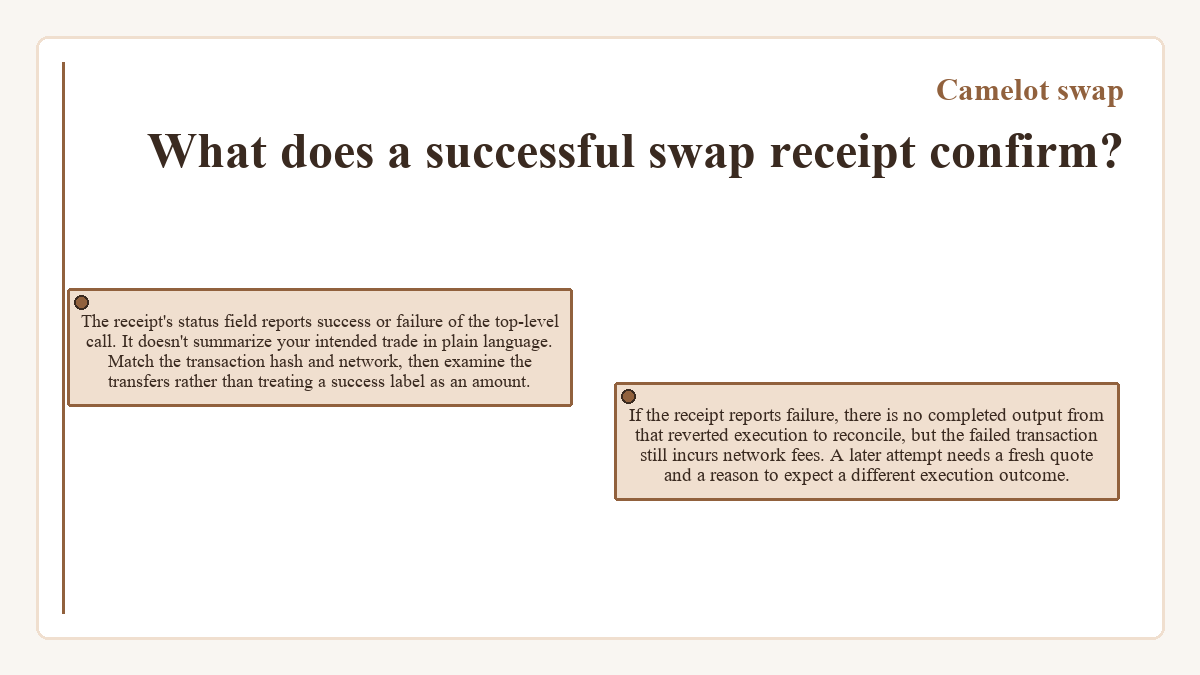
The receipt's status field reports success or failure of the top-level call. It doesn't summarize your intended trade in plain language. Match the transaction hash and network, then examine the transfers rather than treating a success label as an amount. If the receipt reports failure, there is no completed output from that reverted execution to reconcile, but the failed transaction still incurs network fees. A later attempt needs a fresh quote and a reason to expect a different execution outcome.
Read the output transfer at the recipient
For an ERC-20 output, identify the emitting token contract and the transfer into the intended recipient. Several movements within one swap can describe intermediate routing. Adding every amount in the receipt can count the same value repeatedly.
The emitting contract and receiving address
An ERC-20 Transfer event records the sending address, receiving address, and transferred amount. The log's emitting address identifies the contract that produced it. Match that address to the selected output token. Then match the event's recipient to the expected destination. The transaction's main destination may be a router, so it isn't necessarily the address that receives the output.
The raw amount and token decimals
Event amounts use integer token units. Convert them using the output token's decimal precision, keeping enough digits to compare the minimum accurately. Don't assume that every token uses the same precision. If the display metadata is missing, preserve the raw quantity until you can establish its scale. Rounding a wallet display can hide a small difference.
Logs, balances, and traces answer different questions
Receipt logs usually provide the clearest starting point for an ordinary token output. Balance readings help resolve an apparent discrepancy. A transaction trace becomes useful when internal calls or native-currency transfers explain something that the logs don't show.
| Inspection method | What it reveals | Limit on interpretation | Information or access needed |
|---|---|---|---|
| Decoded receipt logs | Events emitted during execution | Intermediate transfers aren't all recipient output | Transaction hash, network, and event definitions |
| Token balance readings | Account holdings at selected states | Other activity can affect the difference | Token contract, recipient, and suitable state access |
| Transaction call trace | Internal calls, their native-value fields, and call errors | Availability depends on the node or service | Transaction hash and a service that supports tracing |
Choose the method that resolves the missing fact. A trace adds little when the correct token's transfer and recipient balance already agree. Conversely, an event-shaped log from an unexpected contract doesn't prove delivery of the selected token.
Compare delivery with the submitted minimum
The relevant minimum belongs to the transaction that you signed. A new quote after execution can't reconstruct the original condition. Keep expected output and minimum received distinct: the first estimates execution, while the second expresses the lower output bound submitted for the route.
Compare like quantities. A pool's outgoing amount and the recipient's net credit can differ when the token charges a transfer tax. The route's handling of that token determines where its output check applies. If a route checks an intermediate amount, that check alone doesn't establish the recipient's final credit. Don't widen slippage merely to dismiss an unexplained discrepancy; establish which amount the transaction actually checked.
Reconcile network costs separately from token output
Network charges depend on the work that execution requires and the network's applicable pricing. They aren't a fixed deduction from every output token. Keep the fee estimate that accompanied signing, then record the actual transaction charge separately from the delivered token quantity.
The receipt distinguishes gas used by this transaction from cumulative gas used through its position in the block. Using the cumulative field would attribute earlier transactions' consumption to your swap. Where the network includes data-posting costs, use its applicable fee accounting rather than adding a second charge that the reported total already includes.
Trading fees affect the swap economics separately. Don't subtract them again from an output amount that already reflects those fees.
Why can the wallet balance disagree with the receipt?
A wallet balance can differ from a receipt's transfer amount because it includes existing holdings, other activity, or network fees when the output is native currency. Compare amounts within the same account and network before investigating the route.
Other activity around the swap
A later balance includes transfers after the exchange. Even comparing adjacent block-end balances can include other transactions within the swap's block. For an ordinary token, isolate movements involving the recipient during the relevant interval. A historical balance read needs a service that retains the necessary state. If logs and isolated balance changes still disagree, examine the token's behavior rather than assuming its events capture every balance effect.
Native currency and wrapped tokens
Native-currency delivery requires a different check from an ERC-20 transfer. Internal call traces can show native value reaching the recipient. Count only actual value transfers whose call and enclosing calls didn't revert. When that recipient also pays gas, its balance increase can be smaller than the gross amount delivered. A wrapped token has its own contract balance; keep it separate from native currency even when the interface presents a related name.
Preserve the discrepancy before another exchange
Keep the transaction hash, network, token contract, recipient, and submitted quote details together. Add the exact transfer or balance difference that remains unexplained. This gives a support investigation something concrete to examine without repeating the exchange.
If the recipient received the expected asset and the isolated amount satisfies the applicable minimum, the remaining issue may be display reconciliation. If the destination or net amount remains unexplained, resolve that difference before making another trade. A new transaction creates a separate exchange; it doesn't repair the receipt of the previous one.
Things people ask about Camelot swap
Can I inspect a Camelot swap receipt without connecting my wallet?
You can inspect a public transaction receipt without connecting your wallet or signing a message. A transaction lookup needs the hash and the correct network. Reading the receipt doesn't authorize token spending or require a recovery phrase.
Why does the transaction show zero value when I spent tokens?
The transaction's value field describes native currency sent with the top-level call, not the quantity of ERC-20 tokens exchanged. A token swap can therefore show zero native value while moving tokens through contract calls. Look at the input token's transfers to establish its movement; the value field alone doesn't measure the trade.
Does the receipt preserve the original quoted output?
A standard transaction receipt doesn't preserve the interface's original quote. It records execution information, including status and logs. Transaction input data may contain the submitted output constraint, depending on the route, but that doesn't recreate the earlier quoted estimate. Keep a separate record of the quote if you want to compare estimated and delivered output later.
Which fields distinguish separate transfers when I export the logs?
The transaction hash and log index distinguish individual log entries within a particular chain record. Keep the network and block hash with them when storing exports. Matching token addresses and amounts alone can accidentally merge separate transfers. Conversely, counting duplicate copies of the same log can inflate the apparent output.
How does a reverted call affect its transfer logs?
A reverted call discards the logs produced within its reverted execution. A detailed trace may still expose attempted operations, but those attempts aren't completed transfers. If an outer contract handles an internal failure and continues, the final receipt can contain logs from other successful parts of the transaction. Read the failure's scope before attributing output.
Is a successful receipt the same as transaction finality?
A successful receipt reports execution in a block; finality concerns whether the chain has settled that block under its confirmation rules. Those are different properties. A success label alone doesn't describe every settlement stage of the network. For records that require final settlement, retain the block information and distinguish execution status from the network's finality status.